High-Speed ROI Detection
Overview
The provided ROI (Region of Interest) detection algorithm analyzes event frames generated by DELTA cameras and rapidly identifies regions with concentrated event activity.
Detected regions are returned as bounding boxes and can be used in downstream processing such as object tracking, image analysis, and neural network inference. Processing only selected regions instead of the entire frame can also reduce the computational load of the overall system.
The algorithm uses a lightweight structure that analyzes the spatial distribution of events within each frame. It runs efficiently in CPU environments without requiring a separate GPU and can be applied to high-speed event streams from DELTA cameras in real time.
Key Features
- Fast CPU-based ROI detection
- Real-time ROI detection with DELTA camera operating at up to 2,000 FPS
- Support for 960 x 720 event frames
- Simultaneous detection of multiple event-active regions
- Bounding box coordinates as detection results
- Easy integration with DELTA SDK APIs
How It Works
The algorithm uses grayscale event frames generated by a DELTA camera as its input.
DELTA DVS Camera
        ↓
High-speed event stream
        ↓
Accumulated event frame
        ↓
Event activity analysis
        ↓
ROI detection
        ↓
Bounding boxes
It searches the input frame for continuous event-active segments and combines spatially connected segments into ROIs.
The detection process consists of the following steps:
- Scan the input event frame row by row.
- Detect continuous segments with concentrated event activity in each row.
- Connect event-active segments across adjacent rows.
- Calculate the minimum and maximum coordinates of each connected region.
- Return the detected regions as bounding boxes.
Because the algorithm primarily uses accumulated scores and coordinate comparisons, it requires relatively little computation and runs efficiently on a CPU.
Detection Result
The image below shows the ROI Detection algorithm applied to a live event stream from a DELTA camera. Green bounding boxes indicate regions with concentrated event activity.
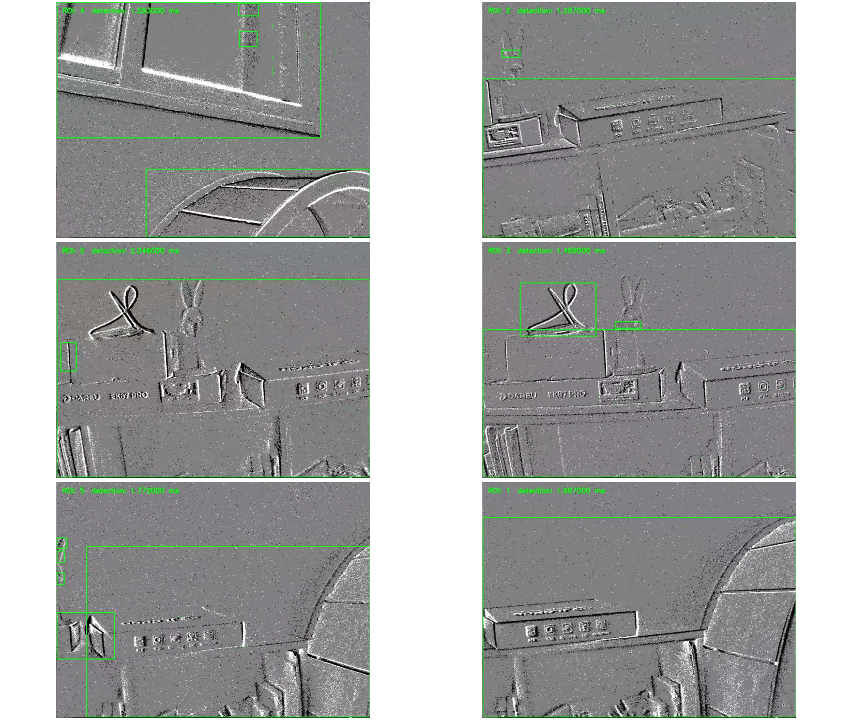
This result shows real-time ROI detection with the camera operating at 2,000 FPS and every 20 sensor frames accumulated into a single input frame.
Applications
Detected ROIs can be used as inputs to a variety of downstream processing stages.
- Candidate region generation for moving objects
- Initial region generation for object tracking algorithms
- Reduced input regions for neural network and NPU inference
- Lower computational cost compared with full-frame processing
- Real-time monitoring of event-active regions
- High-speed inspection and automation systems
- Custom image-processing applications using DELTA cameras
Source Code
ROI Detection is provided as a C++ reference implementation for Linux environments.
The source code is available in the algorithm directory of the embeddedsw repository
git clone https://github.com/nrvcorp/embeddedsw.git
cd embeddedsw/algorithm
You can use this implementation as a starting point and adapt it to your application.
Limitations
For the most stable detection results, the camera should remain stationary while the target objects move. If the camera itself moves, static background edges and textures also generate events, which may cause background regions to be detected as ROIs.