About NRV
NRV develops event-based vision technology for machines that need to follow fast motion and changing scenes. Our goal is to help engineers capture rapid changes and use that information in applications such as industrial inspection, robotics, and motion analysis.
We bring together sensing technology, camera hardware, and software tools to help customers move from exploring event-based vision to building with it. Our cameras, software development kit (SDK), and documentation support that process, from the first data capture to application development.
Why event-based vision?
For a machine inspecting a moving part or tracking a fast object, what happens between images can matter. Conventional cameras record complete images at set intervals. Capturing more images can reveal finer motion, but also increases the amount of data to transfer and process.
A Dynamic Vision Sensor (DVS) takes a different approach: each pixel detects changes in brightness. These changes are called events, and they indicate where the scene has become brighter or darker. This allows a vision system to focus on changes in the scene, making DVS useful for observing fast motion without repeatedly recording an entire unchanged background.
NRV's approach
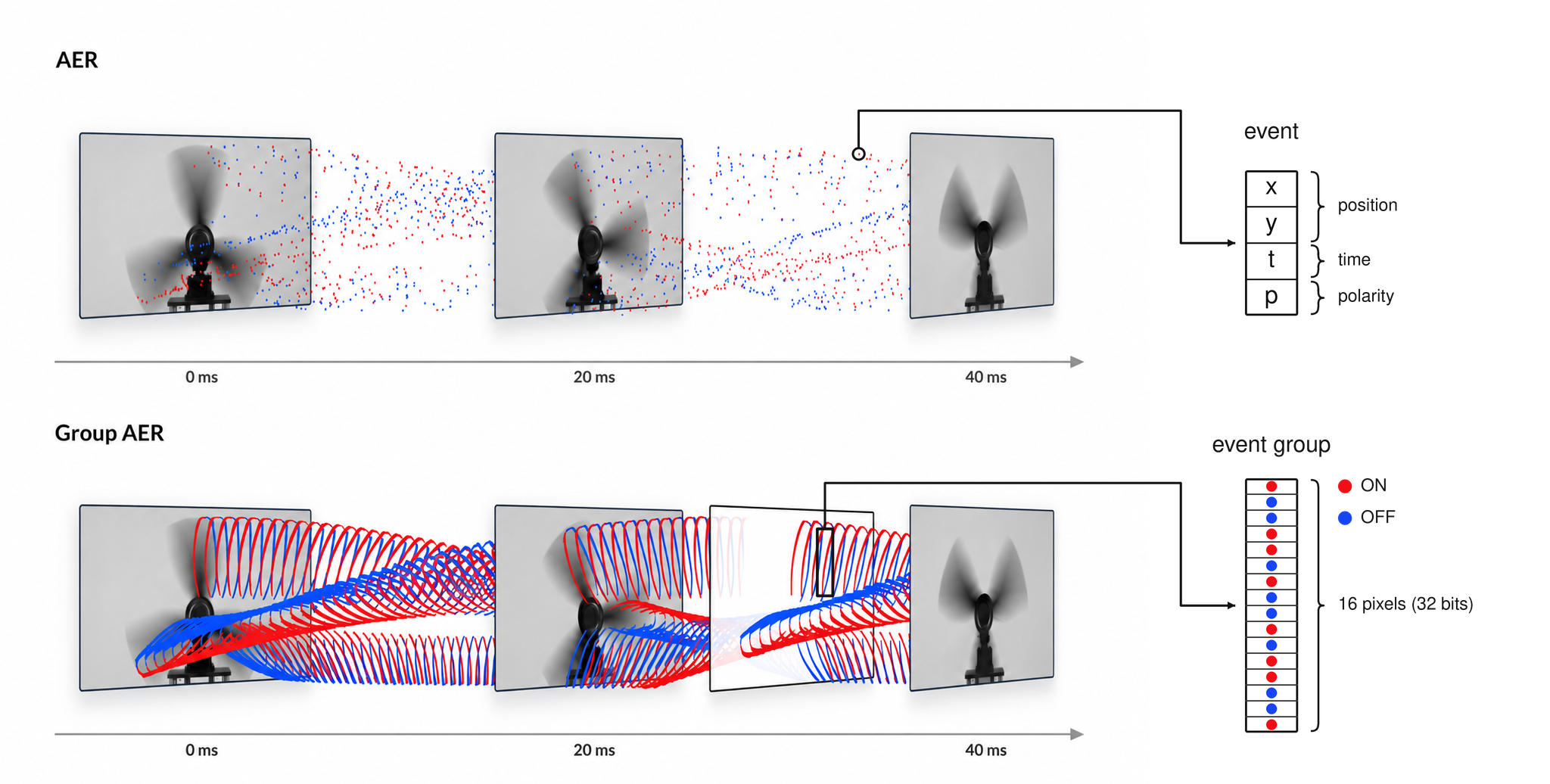
Conventional event-based cameras use Address Event Representation (AER) to represent events. Each event includes its pixel location, the direction of the brightness change, and a timestamp indicating when it occurred. Transmitting a separate timestamp and address for every event increases bandwidth demands as event activity rises.
NRV's event cameras use the Group AER format to represent event data more efficiently. The event states of up to 16 pixels are packed into a single 32-bit packet, using just 2 bits per pixel. Pixel event states captured at each sampling instant are also grouped into an event frame that shares a single timestamp, eliminating the need to transmit a separate timestamp for every event.
Group AER preserves each pixel's event state within the group while reducing the number of bits required to transmit it. This allows more pixel events to be transmitted within the same bandwidth. During event bursts, when many events occur within a short period, this efficiency helps preserve motion details that could otherwise be lost due to bandwidth limitations.
For more details, please refer to our camera product descriptions and SDK documentation.
Start building with NRV
Explore our cameras to find a starting point for your application, then use the SDK and guides to connect a device and work with event data.
To discuss camera selection or your application requirements, contact us at sales@nrv.kr